LU Services
 League of Retired Professors
 News
 Vacancies
 International Relations
 Library
 Contact Us
 Email


The Faculty of Pedagogy organized its annual international “Future of Educational Research in Lebanon: Challenges and Opportunities”
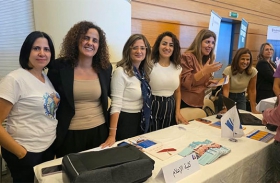
The Center for Educational Studies & Research at the Faculty of Pedagogy organized its annual conference entitled “The Future of Educational Research in Lebanon: Challenges and Opportunities,” under the patronage of President Bassam Badran, represented by the Dean of the Faculty of Pedagogy, Dr. Khalil Al Jammal, and in the presence of the Director of the Educational Center for Research and Development, Dr. Hiam Ishac, and a large gathering of academic officials, professors, and student researchers from the Lebanese University, private universities, and educational institutions.
The conference opened with the Lebanese national anthem and the university anthem, performed by music education students from the faculty under the direction of Dr. Marie Abou Jaoude, who also served as the master of ceremonies.
Following that, the conference chair, Dean of the Faculty of Pedagogy Dr. Khalil Al Jammal, delivered an opening address, beginning with a minute of silence in memory of Dr. Mariam Raad—a former member of the Scientific Committee of the Center for Educational Studies and Research—and students Mohammad Shoucair and Adel Kaddouh, who were killed in the Israeli aggression against Lebanon last year.
Dean Al Jammal emphasized that educational research is an essential tool for understanding the problems facing educational institutions, analyzing their causes, and evaluating existing practices, and proposing solutions based on scientific evidence, thereby contributing to the development of educational policies and plans, improving the quality of education, and achieving equity in learning opportunities.
Dean Al Jammal noted that the education sector in Lebanon faces complex challenges related to disparities in learning opportunities, the development of curricula and educational programs, and rapid digital transformations. He added that keeping pace with the new pre-university curricula, which were prepared by the Educational Center for Research & Development and approved by the government, requires serious preparation for the implementation phase through the training of teachers and educational staff, the provision of necessary resources, monitoring of implementation, and evaluation of results based on field data.
Regarding the use of technology and AI in education and scientific research, Dean Al Jammal emphasized the need to distinguish between technical application and scientific knowledge, noting that digital progress does not replace critical thinking and the scientific method, and that the use of these technologies should respect scientific integrity, privacy, and ethical responsibility.
He also highlighted the academic and national role played by the Faculty of Pedagogy, as the university’s core and its founding faculty, explaining that commemorating the 75th anniversary of its founding in 1951 is not merely a matter of taking pride in its historical legacy, but also serves as an occasion to renew our commitment to its mission of preparing educational professionals, developing research capabilities, strengthening the link between theory and practice, and contributing to shaping a future of education that is of higher quality, more equitable, and more sustainable.
Dean Al Jammal noted that the advancement of educational research requires strengthening collaboration among researchers and academic and educational institutions, providing genuine opportunities for young researchers to participate in and produce scholarly work, and working to translate research findings from academic publications into educational practice and decision-making.
He also emphasized that the future of educational research in Lebanon hinges on the ability to transform challenges into scientific questions, questions into reliable knowledge, and knowledge into initiatives and practices that have a tangible impact on the lives of learners and the performance of educational institutions.
Following this, the conference coordinator and director of the Center for Educational Studies and Research, Dr. Iman Khalil, delivered an opening speech entitled “Toward a Collaborative Vision for the Future of Educational Research in Lebanon,” in which she drew on the 2025 Program for International Student Assessment (PISA) indicators as a starting point for research questions that require interpreting the results and understanding their contexts, emphasizing that the challenge lies not only in producing studies but also in making use of their findings.
The conference proceedings were divided into ten scientific sessions, each featuring four research papers, in addition to a forum for research by master’s students in the Faculty of Pedagogy, bringing the total number of research presentations to sixty. The research addressed the conference’s five themes: sustainable learning and teaching, digital learning and innovation, societal challenges and their impact on education, the state of educational research in Lebanon, and partnerships and capacity building.
The conference concluded with a set of recommendations presented by Dr. Asia Al Mohtar, a member of the Scientific Committee at the Center for Educational Studies & Research, which she prepared in collaboration with her colleagues on the committee, Dr. Randa Naboulsi and Dr. Paula Abou Tayeh. The most notable of these recommendations were:
- Organizing educational research output and making it available digitally by creating indexes of university theses and dissertations, digitizing university libraries, and preparing clear summaries of findings tailored to researchers, practitioners, and policymakers
- Strengthening the link between research, practice, and educational policies through collaboration between researchers and teachers, and encouraging action research to support evidence-based decision-making
- Developing research capabilities, instilling research ethics, and promoting critical and responsible use of digital tools and artificial intelligence
- Expanding the scope of research on issues of sustainability, digital transformation, and innovation; the impacts of crises and conflicts on education; and teacher preparation across all levels and pathways of education
- Fostering ongoing participatory dialogue between universities and educational institutions regarding the priorities of educational research in Lebanon and the conditions necessary for its sustainability.
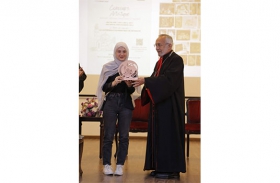
At the conclusion of the conference, one outstanding research paper was selected from each scientific session, and the paper presented by Dr. Asaad Yammine, a research professor at the Faculty of Pedagogy, received the highest distinction among the outstanding research papers.